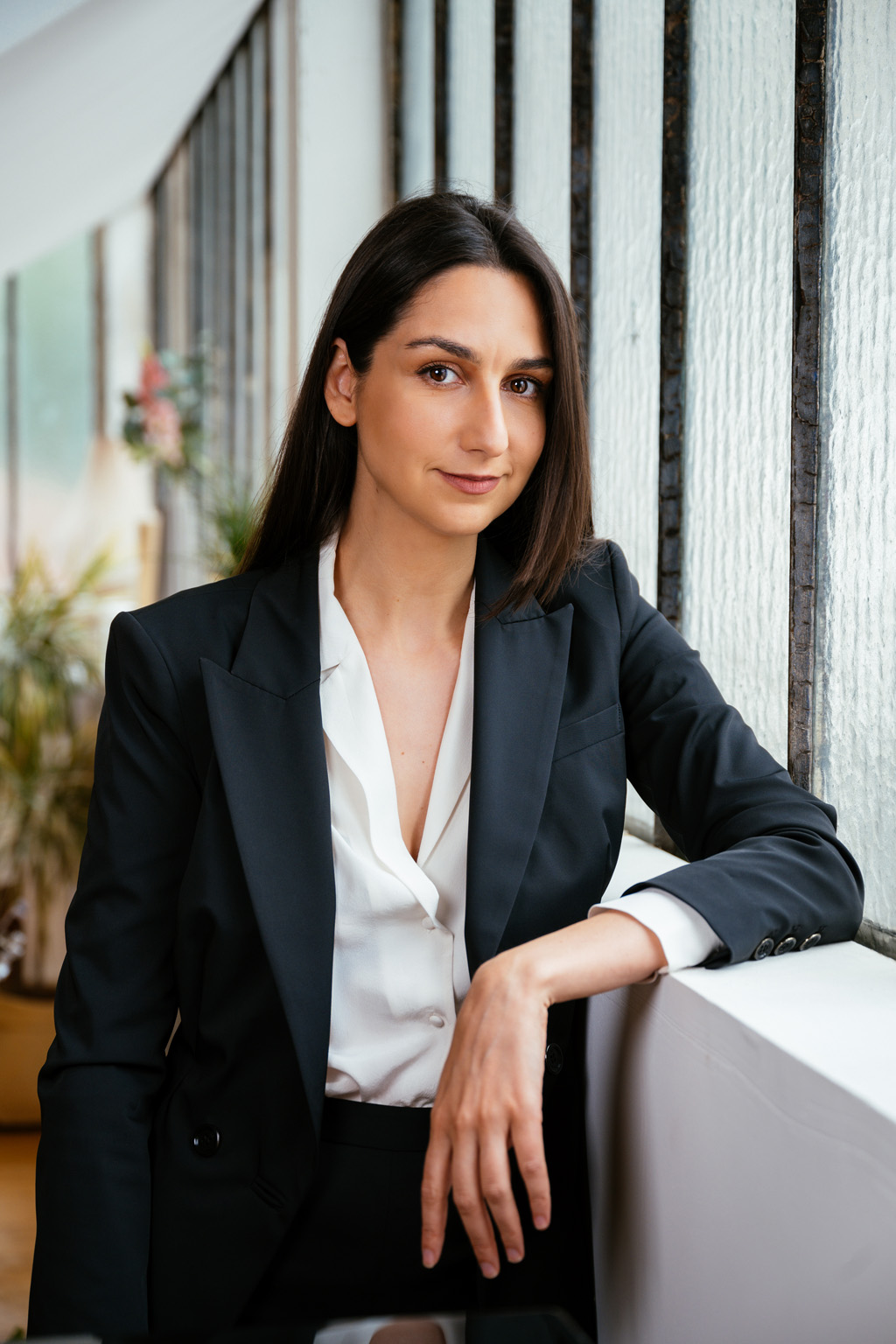
“For a good lawyer, theory and practice are two sides of the same coin”
Marija Šobat, senior associate at Gaillard Banifatemi Shelbaya Disputes.
Were you always destined to be a lawyer?
Well, what I can say is that I was exposed to the law from early on! My mom was a Court of Appeal judge and the President of the First Basic Court in Belgrade, and I really loved being in that environment. Even as a kid, I would go to the court after school, just to do my homework in her chambers or to observe from the back of her courtroom. At first, it was just fun to be a kid somewhere that kids are generally not supposed to be. I felt the excitement of the atmosphere—the frenzy of ongoing proceedings, the people rushing about, the heightened emotions of a dispute. I had the impression that serious things were happening, and I wanted to be a part. I suppose my brother feels the same, since he also became a lawyer. It’s not easy for my dad with three of us in the family!
How did you come to focus on arbitration?
I was introduced to international arbitration while studying for my private international law exam during my final year at the Faculty of Law, University of Belgrade. The chapter covering arbitration was relatively short, but to me it was profoundly impactful. From that moment on, I have never really stopped reading, thinking, or writing about international arbitration, and international law more broadly. I was drawn in: the stories, the cases, the theories, the history. Both investment arbitration—which bridges the traditional divide between public and private international law—and commercial arbitration—with the most interesting interplay of substantive and procedural issues—have captivated me in equal measure.
Let’s talk about what you did to further that interest.
At first, I simply started reading. The very first book on arbitration I picked up was Fouchard Gaillard Goldman on International Commercial Arbitration. Mind you, this was long before I could have imagined learning from or working with Emmanuel Gaillard.
After that, I was working on a paper, and I came across a keynote by Johnny Veeder, in which he quoted an English lord who had reportedly said—extra-judicially—that the New York Convention on the Recognition and Enforcement of Foreign Arbitral Awards was not only “the best thing since sliced bread”, but also “whatever was the best thing before sliced bread”. I wanted to understand what was so special about the New York Convention—not only the text and the application by domestic courts, but how it came to be, the treaty negotiations in the 1950s, and the effect of the Convention on international arbitration and global trade. I got hooked and happily fell all the way down the rabbit hole (and the travaux préparatoires!).
You wrote it just for you as a hobby?
Not exactly. I do enjoy the law, but I wouldn’t go so far as to say I write papers for fun! At the time, there was an opportunity to present the paper at an annual conference in Kopaonik, founded more than thirty years ago by Prof. Slobodan Perovic, at one of Serbia’s most beautiful ski resorts. My mother was planning to attend the same conference. I thought it would be a wonderful chance for us to go together. So we did, and we had a fantastic time in Kopaonik that year.
So, where was your next stop after the University of Belgrade—after becoming interested in international arbitration?
After spending some time volunteering at a first instance court and working at a law firm in Belgrade (a requirement to sit for the bar exam in Serbia), I pursued a Master in International Commercial Law at the La Sapienza University in Rome, with a scholarship from the Italian Ministry of Foreign Affairs, awarded to Serbian students fluent in Italian. In fact, I had simultaneously applied for the Master in International Dispute Settlement (MIDS) in Geneva, and the two programs overlapped for a couple of months. I did not want to postpone the MIDS, because I had received the Hans Wilsdorf scholarship, and the program, which is all about international dispute settlement, was exactly what I wanted to be doing. This arrangement meant accelerating my studies in Rome and putting in some extra effort to prepare a Master Thesis as well as travelling back to Rome to defend it while already attending MIDS courses in Geneva. But it was worth it! During the MIDS, I was taught international arbitration by some of the very best in the field, and I truly had the best time.
Is that where you met one of your mentors?
Yes! It was at the MIDS that I first met Professor Emmanuel Gaillard. I was researching manifestly frivolous claims (which later became the subject of an article I co-authored), and I had many questions about the application of that objection. Emmanuel Gaillard had sat on the Global Trading v. Ukraine Tribunal—one of the first investment tribunals dealing with the issue in the ICSID context—and he was teaching one of my courses. He generously responded to my myriad of questions, and we had an interesting discussion about the Global Trading award. About a week later, the MIDS director told me that Emmanuel Gaillard encouraged me to apply for an internship at his firm back then, Shearman & Sterling LLP. I submitted my application the same day. After that, I read everything I could get my hands on that Emmanuel Gaillard had written. I ended up interviewing from Washington D.C., where I was interning with the then-President of the AAA/ICDR Bill Slate—another fantastic experience.
Do you remember this interview?
Of course I do. Yas Banifatemi, who was interviewing me, read in my application that I had written about the New York Convention and asked me about the proposed revision to the Convention, as well as my opinions on the debate that followed such proposed revision. I knew that Emmanuel Gaillard had given a speech at the ICCA Congress in Dublin in 2009 and subsequently written an article on this issue—“The Urgency of Not Revising the New York Convention”—and I agreed with his views. But I didn’t want to come across as if I was agreeing just because I was trying to get the internship. I wanted to show that I had thought through it. So, I enthusiastically made my points—perhaps a bit too many and too fast. Still, Yas Banifatemi took a chance on me, and I got the offer. It was a dream come true.
And that was your very first internship at an international law firm?
It was, and I had no idea what to expect. I just knew that I wanted to work with that team at Shearman at the time. I certainly didn’t expect to have so much fun while working so hard, or that the friendships I made then would last all these years. Indeed, this feeling that I can rely on the people in this team, whatever the seniority, when work gets intense only grew stronger over the years.
You had a couple other stops before you settled in Paris, though, right?
Yes, I did an LLM at Harvard Law School. Actually, I only took one arbitration-related class at Harvard. My friends and I realized that there was no platform for students to discuss arbitration-related topics. The four of us wanted to create that platform—for our benefit and that of future JD, LLM, and SJD students—and to see international arbitration growing as a practice of interest at Harvard. So we founded the Harvard International Arbitration Law Students Association (HIALSA), and our inaugural event in 2015 was with Emmanuel Gaillard and Yas Banifatemi discussing their historic win in Yukos the previous year. That same year, we organized the first Harvard International Arbitration Conference (HIAC), and had Professor Zachary Douglas deliver a keynote. The HIALSA celebrated its 10th anniversary in 2025! I’m really happy and proud to see that HIALSA did what we hoped it would: boost the interest in international arbitration at Harvard, with more arbitration-related courses being offered now. I was also admitted to the New York bar and had begun a PhD in international law (which I hope to complete one day!) at the Graduate Institute in Geneva.
After almost ten years of practice, what do you see as the advantages of arbitration?
Neutrality is really the core advantage. When you have a dispute with an international element, neither the party from State X nor the party from State Y wants to go before the courts of the other country. No one wants home advantage, and arbitration offers a neutral judge vis-à-vis both parties.
The second benefit is having specialized decision-makers. Of course, independence and impartiality are baseline requirements. Beyond that and depending on the dispute—such as gas price review, intellectual property or construction delay analysis—the parties can choose an arbitrator with a certain expertise directly relevant to the dispute submitted to arbitration.
The third, and quite straightforward, benefit is that it is easier to enforce an arbitral award under the New York Convention than it is to enforce a domestic judgment, especially in a foreign jurisdiction.
All these aspects speak to the fourth benefit of arbitration that I’d like to mention, which is the flexibility that it affords the parties in creating the procedure that suits the dispute. I recently completed a confidential case that concerned a fast-paced, constantly-changing, always-evolving situation where time was of the essence. In this context, it is important that the arbitration process can be accelerated, something that is not always possible under pre-established procedures applicable before domestic courts.
What if one party wants to get out of the arbitration?
First of all, consent to arbitration is key, and once given, it cannot be unilaterally revoked. Second, there is nothing new about a party trying to renege on previously freely accepted arbitration agreement. In fact, some of the most universally accepted rules of international arbitration, such as the separability of the arbitration agreement or the competence-competence principles, were developed in response to attempts by parties to obstruct an ongoing arbitration. Emmanuel Gaillard, in fact, gave a wonderful keynote speech on this topic and wrote about it in “Seven dirty tricks to disrupt an arbitration and the responses of international arbitration law”; the article shows how the history of international arbitration has been one of constant adaptation to attempts by recalcitrant parties to disrupt arbitration proceedings in the hope of avoiding being bound by an award rendered on the basis of an arbitration agreement they previously accepted.
What type of cases have you been working on?
My first hearing—many years ago—was before the Court of Arbitration for Sport, just after the MIDS and before joining Shearman. My most recent hearings were two commercial arbitrations in Geneva, where I was part of the team representing subsidiaries of a Gulf sovereign wealth fund in a dispute over breaches of several finance agreements. A great deal has happened in-between. I have worked on a wide range of commercial and investment arbitrations, public international law matters, and enforcement proceedings before the U.K. and U.S. courts.
For example, I have worked on disputes including an inflated cost-recovery claim in the oil & gas sector; a sponsorship agreement involving Real Madrid’s Santiago Bernabéu Stadium in Madrid; an aluminium and alumina production company in Ukraine; and a dispute over indemnification for potential losses connected to a mass tort litigation in the United States over a recalled drug. Our firm was also appointed by the Superior Court of Quebec, and I was part of the team that submitted an amicus curiae brief addressing the concept of party consent, a tribunal’s mandate to resolve disputes specifically referred to it for its determination, and the functus officio doctrine. More recently, I was part of the team advising a state-owned company on a cross-border pipeline project and associated processing agreements.
There is truly never a dull moment, and there is really neither a pattern nor established steps to follow when taking on a new case; every case is different and requires a different approach, both procedurally and substantively. Also, at Gaillard Banifatemi Shelbaya Disputes, we deal with all aspects of disputes, in the sense that we get involved in the actual arbitration proceeding if there is one, but we also assist our clients with advisory work and negotiations, something that can be as exciting as an arbitration process itself. And we of course also advise and represent our clients in enforcement and annulment proceedings.
Is it this diversity that keeps you engaged?
Actually, it’s the challenge of getting it right and continuing to learn. I have always been someone who is motivated by a challenge. When I get a new case, the challenge is to approach the facts from the right perspective, to understand the law, to ask the right questions, to take the right angles, and to put down the right arguments. You can never be complacent when practicing in this field.
What would be your next goal?
I was lucky enough to assist Emmanuel Gaillard with a number of academic projects. For him, writing and speaking about the legal theory and practice of international arbitration and international law was an integral part of his practice of the law. Through that work, not only did I learn a great deal from him about how to do proper research or think about an issue, but I also saw firsthand how knowledge provides an advantage. The more you know, the more your thinking can become sophisticated and creative.
Actually, I can give you an example: When Emmanuel Gaillard was writing his “Coordination or Chaos” article in 2018, he noted that, although anti-suit injunctions by arbitral tribunals enjoining proceedings before other arbitral tribunals were extremely rare (indeed we found only one example of such a measure in the interim order issued by the Iran-U.S. Claims Tribunal in Reading & Bates v. Iran in 1983), it was conceivable that arbitrators may face circumstances that warrant a reaction against abusive conduct of parties that may attempt to pre-empt or interfere in the tribunal’s jurisdiction. Not too long after he wrote that, in one of his cases, he requested and obtained an anti-arbitration injunction from an arbitral tribunal on the ground that the parallel arbitration was an abuse of right. Nowadays, anti-arbitration injunctions are becoming more and more common to see in both commercial and investment arbitrations, exactly as he had predicted.
From my own experiences, I have to say that I abide by Prof. Gaillard and Yas Banifatemi’s stance that, for a good lawyer, theory and practice are two sides of the same coin. You cannot separate the two. Indeed, I would like to find more time in my own practice to write more. There are a couple of topics that I have wanted to properly address for some time now. I also had the honor to co-teach a class on investment arbitration with Yas Banifatemi at Panthéon-Sorbonne University last year, at her kind invitation. That was a great experience, and I would like to do more of it. To me, these are the next challenges to keep me on my toes!
Interview by Lisa Vignoli